
Quick Answer: Yes, an EV is cheaper to run in the UAE, but the saving comes mostly from energy, not from servicing.
- Maintenance: Count only scheduled services and brakes and an EV looks about 50% cheaper. Count everything (tyres, the 12V battery, fluids, alignment) and the gap shrinks to roughly 10% over five years.
- Energy: With Special 95 at AED 4.04/litre (November 2026), petrol costs about AED 0.40/km. A home-charged EV costs about AED 0.05/km. Public AC costs about AED 0.13/km and public DC about AED 0.21/km.
- Five-year running cost (75,000 km, mid-size car): about AED 45,800 for petrol versus AED 18,000 for an EV charged at home and about AED 30,000 even if you only use public DC chargers.
- Break-even: At 15,000 km a year with home charging, an EV with a AED 25,000 price premium pays itself back in roughly 4.5 years.
- Biggest variables: your annual mileage, whether you can charge at home, and which workshop services the car. Dubai heat adds extra wear on tyres, the 12V battery and the cooling system.
Last updated: 4 November 2026. Fuel prices are the UAE Fuel Price Committee rates for November 2026. All AED figures are indicative planning estimates for a mid-size car at independent-workshop rates, not a quotation.
If you are choosing between an electric car and a petrol car in Dubai, you have probably seen two very different claims: “EVs need almost no maintenance” and “EVs cost more to look after than people think.” Both contain some truth. This guide separates the two, using current UAE fuel prices and DEWA charging tariffs, and shows where the money is actually saved and where it quietly leaks back out.
What Changed in 2026: Petrol Is No Longer Cheap
Most older EV vs petrol comparisons were written when petrol was around AED 2.50 a litre. That is no longer the case.
According to the UAE Fuel Price Committee, Special 95 sat at roughly AED 2.40 in early 2026, climbed through the year to AED 4.28 in October, and eased to AED 4.04 in November 2026.
| Fuel (November 2026) | Price per litre |
|---|---|
| Super 98 | AED 4.16 |
| Special 95 | AED 4.04 |
| E-Plus 91 | AED 3.97 |
| Diesel | AED 4.75 |
Two things follow from this:
- The energy gap between petrol and electric is wider than it has been for years. Any article using AED 2.50 to AED 3.30 petrol understates the EV saving.
- UAE fuel prices are volatile. A single month’s pump price is a weak foundation for a five-year decision, so the break-even section below tests several fuel-price scenarios.
What EV Charging Costs in the UAE
Public charging in the UAE is no longer free. DEWA’s EV Green Charger network charges per kWh:
| How you charge | Rate per kWh | With 5% VAT |
|---|---|---|
| Home (DEWA residential slab, approx.) | AED 0.23 – 0.38 | n/a (included in your bill) |
| Public AC (DEWA Green Charger) | AED 0.70 | AED 0.735 |
| Public DC fast (DEWA Green Charger) | AED 1.20 | AED 1.26 |
A typical mid-size EV uses about 17 kWh per 100 km. At those rates:
| Charging method | Cost per km | Cost per 15,000 km |
|---|---|---|
| Home charging (about AED 0.31/kWh) | AED 0.053 | about AED 790 |
| Public AC (AED 0.735/kWh) | AED 0.125 | about AED 1,875 |
| Public DC (AED 1.26/kWh) | AED 0.214 | about AED 3,210 |
| Petrol (10 L/100 km at AED 4.04) | AED 0.404 | about AED 6,060 |
Takeaway: Even an EV that charges only at expensive public DC chargers costs roughly half as much to fuel as a petrol car at today’s prices. Home charging cuts the energy bill by almost 90%.
What an EV Eliminates, and What It Doesn’t
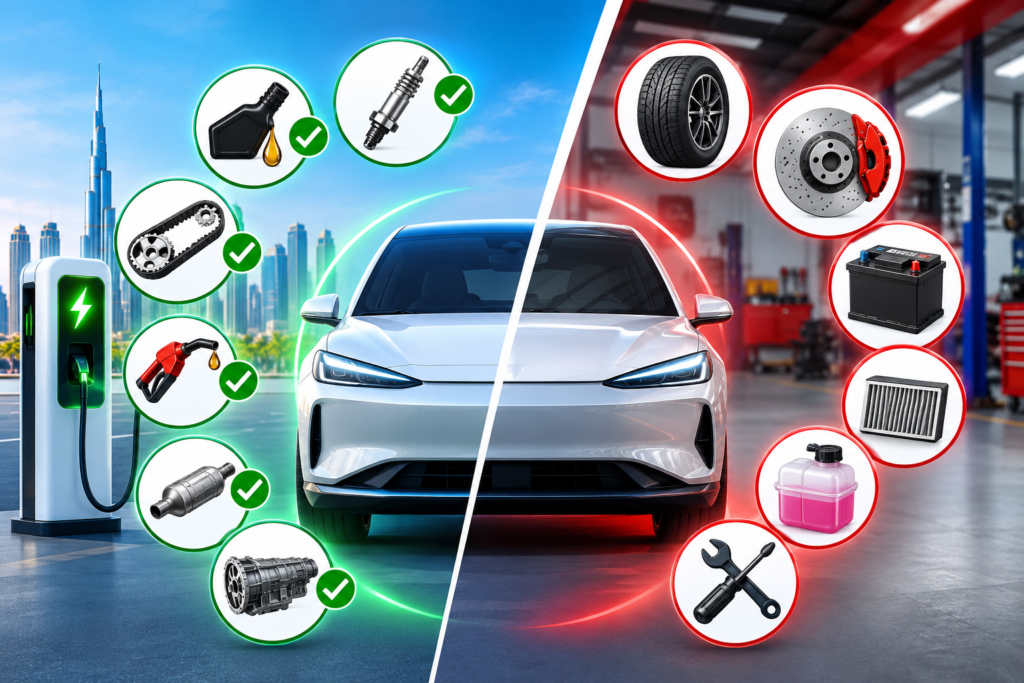
Maintenance an EV removes
- Engine oil and oil filter changes
- Spark plugs and ignition coils
- Timing belt or chain
- Fuel filter, fuel pump service and injector cleaning
- Exhaust system, catalytic converter and oxygen sensors
- Multi-speed gearbox fluid services (most EVs use a single-speed reduction gear with a much longer fluid interval)
Maintenance an EV keeps
- Tyres, which usually wear faster on EVs
- Brake fluid and periodic brake inspection and cleaning
- Cabin air filter and AC / heat pump service
- 12V auxiliary battery, which still fails in Dubai heat
- Coolant for the battery and power electronics (interval depends on the brand, and some manufacturers specify none)
- Wheel alignment, suspension and steering components
- Software updates and diagnostics
Maintenance that can cost more on an EV
- Tyres: extra weight and instant torque wear tyres faster, and EV-rated tyres often cost more.
- Labour rates: high-voltage work needs trained technicians and specific tooling. At a dealer this can erase much of the servicing saving.
- Body and collision repair: battery-pack proximity and aluminium structures make some repairs more specialised.
- Insurance: premiums for EVs are often somewhat higher than for comparable petrol cars. Get quotes before you buy.
Five-Year Maintenance Comparison (75,000 km)
Assumptions: mid-size car, 15,000 km a year, independent Dubai workshop rates, one major service on the petrol car, annual servicing on the EV. These are central estimates; real bills vary by model and workshop.
| Cost line (5 years) | Petrol (AED) | Electric (AED) | Cheaper |
|---|---|---|---|
| Scheduled servicing | 5,500 | 3,000 | EV |
| Brakes (pads, discs, fluid, cleaning) | 2,300 | 900 | EV |
| 12V battery (replaced about twice) | 1,000 | 1,300 | Petrol |
| Tyres | 3,500 | 4,800 | Petrol |
| AC service and cabin filters | 900 | 700 | EV |
| Coolant and drive-unit fluids (outside service packages) | included above | 1,000 | Petrol |
| Alignment, wipers, diagnostics, misc. wear | 2,300 | 2,300 | Tie |
| Five-year total | about 15,500 | about 14,000 | EV by about AED 1,500 |
| Per year | about 3,100 | about 2,800 | |
| Per km | about AED 0.21 | about AED 0.19 |
Plausible range: AED 11,000 – 21,500 for petrol and AED 9,500 – 21,000 for an EV, depending on model, tyre choice and workshop.
Why you see claims of “40–60% lower maintenance”
Add up only scheduled servicing and brakes, and the EV total is about AED 3,900 against AED 7,800 for petrol, roughly 50% lower. That is where the headline figure comes from. Once you include tyres, the 12V battery and fluids, the gap shrinks to roughly 10%. Neither number is “wrong.” They measure different things, which is why it pays to ask what a quote or article is counting.
Five-Year Total Running Cost: Maintenance Plus Energy
| Scenario (75,000 km) | Maintenance | Energy | Total |
|---|---|---|---|
| Petrol (AED 4.04/L, 10 L/100 km) | about 15,500 | about 30,300 | about 45,800 |
| EV, home charging | about 14,000 | about 3,950 | about 18,000 |
| EV, mixed (70% home, 20% AC, 10% DC) | about 14,000 | about 6,250 | about 20,250 |
| EV, public AC only | about 14,000 | about 9,370 | about 23,400 |
| EV, public DC only | about 14,000 | about 16,065 | about 30,050 |
At November 2026 prices, even the least favourable EV charging scenario beats petrol on running cost. The catch is the purchase price, which is where break-even comes in.
Break-Even: When Does an EV Pay for Itself?
Break-even (years) = EV price premium ÷ annual running-cost saving
At 15,000 km a year with home charging, the annual saving is about AED 5,570 (energy about AED 5,270 plus maintenance about AED 300).
| EV price premium over a comparable petrol car | Break-even (home charging) | Break-even (public AC) |
|---|---|---|
| AED 25,000 | about 4.5 years | about 5.6 years |
| AED 40,000 | about 7.2 years | about 8.9 years |
| AED 60,000 | about 10.8 years | about 13.4 years |
Does annual mileage change the answer?
| Annual distance | Petrol energy cost / yr | EV home energy cost / yr | Energy saving / yr |
|---|---|---|---|
| 8,000 km | about AED 3,230 | about AED 420 | about AED 2,810 |
| 15,000 km | about AED 6,060 | about AED 790 | about AED 5,270 |
| 25,000 km | about AED 10,100 | about AED 1,320 | about AED 8,780 |
| 40,000 km (fleet / ride-hail) | about AED 16,160 | about AED 2,110 | about AED 14,050 |
What if fuel prices fall back?
| Special 95 price | Petrol cost per km | Annual petrol energy (15,000 km) | Saving vs home-charged EV |
|---|---|---|---|
| AED 3.00 | AED 0.30 | AED 4,500 | about AED 3,710 |
| AED 4.04 (Nov 2026) | AED 0.40 | AED 6,060 | about AED 5,270 |
| AED 4.50 | AED 0.45 | AED 6,750 | about AED 5,960 |
Even if petrol falls back to AED 3.00, the energy saving is still significant. Home charging is the lever that matters most.
The High-Voltage Battery: How Worried Should You Be?
The battery is the cost most buyers fear, so here is a realistic view.
- Warranty: Most EVs sold in the UAE carry a long battery warranty, commonly around 8 years or a set distance, usually with a minimum capacity guarantee. Check the exact terms for your model.
- Replacement cost (out of warranty): From roughly AED 15,000 for smaller packs to AED 50,000 or more for large premium packs. Prices vary widely by model, and module-level repair is sometimes possible instead of a full pack replacement.
- Failure is the exception: Gradual capacity loss is normal and usually modest in the first years. Sudden full-pack failure within warranty is uncommon.
- Heat is the real UAE risk factor. Sustained 45°C+ ambient temperatures, parking in direct sun and frequent DC fast charging all accelerate degradation. Models with liquid-cooled battery packs handle this far better.
Protecting your battery in Dubai
- Park in shade or covered parking whenever possible.
- Avoid leaving the car at 100% charge in direct sun for long periods. Many owners keep daily charging within a moderate range unless they need the full range for a trip.
- Use AC charging for routine top-ups and keep DC fast charging for trips.
- Keep the AC condenser and cooling system clean and serviced, because battery thermal management depends on it.
- Before buying a used EV, get an independent battery health check as part of a pre-purchase inspection.
EV Maintenance in Dubai’s Climate
Dubai is a tougher test for an EV than many of the markets where these cars were developed.
- Tyres: Hot asphalt and heavy cars accelerate wear. Rotate tyres roughly every 10,000 km, check pressures monthly and replace on age as well as tread.
- 12V battery: Heat shortens its life to roughly two to three years. When it fails, many EVs will not wake up even with a full traction battery, so proactive testing is cheap insurance.
- AC and thermal management: Heavy AC use reduces range and loads the cooling system. Service the AC before summer.
- Brakes: Regenerative braking means pads last much longer, but rarely used brakes can corrode in humid conditions, so periodic cleaning and inspection matter.
- Dust: Cabin filters and cooling intakes clog with dust faster in the UAE than in many other markets.
Hybrid vs EV vs Petrol: Where Does a Hybrid Fit?
A hybrid keeps almost every petrol-car service item (oil, filters, plugs) but adds regenerative braking, so pads last longer, and uses less fuel. It suits drivers who:
- cannot install a home charger,
- regularly make long intercity or desert trips, or
- want lower fuel cost without changing their routine.
A plug-in hybrid can be the cheapest to run if you can charge at home and mostly drive short distances, but it carries the maintenance load of both systems.
Luxury EVs vs Luxury Petrol Cars
Premium EVs such as the Porsche Taycan, Mercedes EQS and Tesla Model S/X bring their own cost profile:
- They avoid engine and gearbox servicing, which is a large saving on a luxury petrol car.
- They often use large, expensive tyres and air suspension, which stay on the bill.
- Dealer labour rates for high-voltage work can be high, which makes a qualified independent specialist worth finding before the warranty ends.
- Body repair and parts lead times can be longer for newer or lower-volume models.
UAE EV Incentives: What’s Still True
| Incentive | Status |
|---|---|
| Free Salik tag on registration | Yes. The RTA issues the tag free, but EVs still pay AED 4 per Salik gate crossing. |
| Free public EV charging | No. DEWA now charges per kWh (AC and DC rates above). |
| Dedicated EV parking | Yes, green-marked bays in selected areas, typically with a time limit (up to four hours at a time). |
| Registration fee benefits | Reduced or waived in many cases. Confirm the current fee with the RTA. |
| Green vehicle financing | Offered by several UAE banks. Compare rates. |
Which Is Cheaper for Your Driving Profile?
An EV is likely cheaper if you:
- can charge at home or work,
- drive more than about 12,000–15,000 km a year,
- mostly drive within Dubai and Abu Dhabi, and
- plan to keep the car at least five to six years.
Petrol may be cheaper or simpler if you:
- live in an apartment with no charging access,
- drive under about 8,000–10,000 km a year,
- regularly drive long distances beyond the charging network, or
- are buying an older used car on a tight budget.
A hybrid may be the best compromise if you want lower fuel costs but cannot rely on charging.
How to Lower Maintenance Costs on Either Car
Petrol owners
- Service on the schedule, but consider shorter oil intervals in extreme summer heat.
- Test the 12V battery every 12–18 months once it is past two years old.
- Service the AC before summer rather than during a breakdown.
- Move to a qualified independent workshop once the warranty period ends.
EV owners
- Install a home charger. It is the single biggest saving available.
- Use regenerative braking, but have brakes inspected and cleaned periodically.
- Rotate tyres roughly every 10,000 km and buy EV-rated replacements.
- Replace the 12V battery proactively rather than waiting for it to strand the car.
- Find a workshop that can handle EV work before your warranty expires.
Frequently Asked Questions
Are electric cars cheaper to maintain than petrol cars in the UAE?
Slightly, in like-for-like terms. Scheduled servicing and brakes cost much less on an EV, but tyres, the 12V battery and fluids narrow the gap to roughly 10% over five years. The much larger saving is energy cost.
How much does it cost to service an electric car in Dubai?
A routine annual service for a mainstream EV at an independent workshop commonly falls in the AED 400–900 range, and more for premium models or at a dealer. Prices vary by model and scope, so ask for an itemised quote.
Do electric cars need oil changes?
No. EVs have no engine oil. They still need brake fluid checks, cabin filter changes, AC service, tyre rotation and, depending on the brand, coolant and drive-unit fluid changes.
How much cheaper is charging than petrol per km in the UAE?
At November 2026 prices, petrol costs about AED 0.40/km. Home charging is about AED 0.05/km, public AC about AED 0.13/km and public DC about AED 0.21/km.
Is public EV charging free in Dubai?
No. DEWA charges AED 0.70/kWh for AC and AED 1.20/kWh for DC, plus 5% VAT.
Do electric cars pay Salik in Dubai?
Yes. EV owners can get a free Salik tag when registering, but the standard AED 4 charge still applies at every gate.
How much does an EV battery replacement cost in the UAE?
Out of warranty, from roughly AED 15,000 for smaller packs to AED 50,000 or more for large premium packs. Most owners never face this inside the warranty period, and module-level repair is sometimes an option.
Does Dubai’s heat damage EV batteries?
Sustained high temperatures and frequent fast charging accelerate battery ageing. Shaded parking, sensible charging habits and a well-maintained cooling system reduce the effect.
Are EV tyres more expensive?
Often yes. EVs are heavier and deliver instant torque, so tyres wear faster, and EV-rated tyres can cost more. Budget for earlier and more expensive replacement than on a comparable petrol car.
Can an independent garage service my EV without voiding the warranty?
For routine items such as tyres, brakes, AC and the 12V battery, UAE consumer protection principles do not require dealer-only servicing, provided the work is to specification and properly documented. Drivetrain and high-voltage battery work during the warranty period is best kept with an authorised centre.
At what mileage does an EV become cheaper than petrol in the UAE?
With home charging, an EV usually makes financial sense from around 12,000–15,000 km a year. Above 25,000 km a year it pays back considerably faster.
Is a hybrid cheaper than an EV or petrol car?
It depends on your charging access and driving pattern. A hybrid lowers fuel costs without charging infrastructure but keeps the engine’s maintenance items. An EV with home charging usually has the lowest running cost.
The Bottom Line
Electric cars are cheaper to run in the UAE, but not mainly because servicing is cheaper. Servicing and brake savings are real, yet tyres, the 12V battery and fluids claw most of them back. The decisive saving is energy: at today’s petrol prices, a home-charged EV costs a fraction per kilometre, and even all-public-DC charging still beats petrol.
Before you decide, run the numbers with your own annual mileage and your own charging access. Those two variables matter more than the badge on the bonnet.
Maintenance for Both Sides, Under One Roof
Auto Doctor in Al Quoz, Dubai services petrol, hybrid and electric vehicles, including Tesla, BYD, Jetour, MG and Genesis, as well as German, British, American and Japanese brands. We give a written, itemised quote before any work starts, use specification-correct parts and provide pickup and delivery. Whatever you drive, we will tell you what it genuinely needs, and what it does not.
Want a clear maintenance quote for your EV, hybrid or petrol car? Call Auto Doctor or message us on WhatsApp.