
Quick Answer
The most common Rolls-Royce Ghost problems in Dubai are air suspension faults and electronic glitches, and heat makes both appear earlier than in cooler climates.
- Air suspension symptoms: the car sags after parking, a suspension warning appears, the ride feels firmer than normal, the compressor runs longer or strains, or the ride height is uneven.
- Why it’s tricky: the Ghost’s “Magic Carpet Ride” combines air struts with the Flagbearer road-scanning camera, so a warning can come from a mechanical part, a sensor, the camera or software, not always a failed strut or compressor.
- Electronic issues: infotainment glitches, sensor warnings and seemingly unrelated faults are often caused by a weak battery, which is common in Dubai heat.
- Dubai-specific causes: heat degrades air strut seals, dust can dirty the camera and sensors, and heat shortens battery life.
- What to do: get a full diagnostic that checks both suspension and camera systems, keep the Flagbearer camera lens clean, park in shade, fix any hissing sound or sag early, and load-test the battery once a year after it passes 18 months.
The Rolls-Royce Ghost is engineered around its signature “Magic Carpet Ride”, a self-leveling air suspension system paired with camera-based road-scanning technology that reads the road ahead and adjusts damping in real time. It’s one of the most sophisticated suspension systems on any production car, and while it delivers an extraordinary ride when everything is working correctly, its complexity means there’s more that can go wrong than on a conventional system, and Dubai’s climate adds its own layer of stress.
How the Ghost’s Air Suspension System Works
The Ghost uses a four-corner air suspension system integrated with the Flagbearer camera system, which scans the road surface ahead of the vehicle and pre-adjusts damping before the wheels even reach an imperfection. This level of integration means a fault in the suspension system can sometimes originate from the camera or its associated software rather than a purely mechanical component, a distinction that matters significantly for accurate diagnosis.
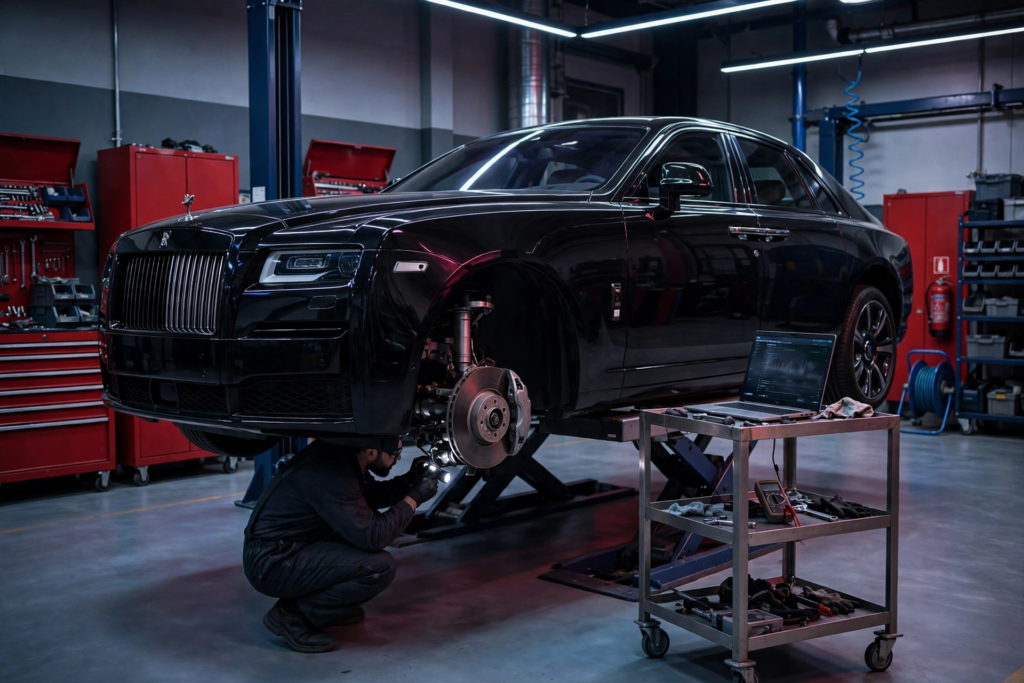
Common Symptoms
- Sagging ride height, particularly noticeable after the vehicle has been parked for an extended period
- Suspension warning message on the dashboard, sometimes causing the system to default to a fixed, less adaptive ride mode
- A noticeably firmer or less refined ride than expected, a meaningful change on a car whose entire character depends on ride quality
- Compressor running longer than normal or producing an audible straining noise
- Uneven ride height side-to-side visible on level ground
- Flagbearer camera-related warning messages, indicating the road-scanning system itself has detected a fault, separate from a purely mechanical suspension issue
Electronic and Infotainment Considerations
Beyond suspension-specific faults, Ghost owners can experience broader electronic quirks common to dense, highly integrated luxury platforms:
- Infotainment or display glitches, sometimes resolved with a software update
- Sensor-related warning lights (parking sensors, night vision, if equipped) that may relate to sensor cleanliness or calibration rather than genuine component failure
- Battery-related symptoms that can present as seemingly unrelated electronic glitches across multiple systems, given how battery health affects voltage stability throughout a densely electronic vehicle
Why Accurate Diagnosis Matters More on the Ghost
Because the suspension system is integrated with camera-based road scanning rather than operating purely mechanically, a warning light doesn’t automatically mean an air strut or compressor has failed, it could equally be a camera calibration issue, a sensor fault, or a software-related glitch. Treating every suspension warning as a hardware failure risks unnecessary parts replacement; a proper diagnostic that distinguishes between mechanical, sensor, and software-related causes is essential before any repair decision is made.
Why Dubai’s Climate Is a Relevant Factor
- Air suspension components, the rubber and fabric-reinforced air struts degrade faster under sustained extreme heat, mirroring the pattern seen across every air suspension platform in this climate
- Camera and sensor cleanliness, dust accumulation, more prevalent in the UAE than in many other markets, can affect the Flagbearer camera’s ability to read the road accurately if not kept clean
- Battery health, heat accelerates battery degradation, and given how central voltage stability is to a vehicle with this level of electronic integration, proactive battery health monitoring is particularly valuable on the Ghost
Diagnostic Approach
- Full suspension and camera system fault code scan, since faults can originate from either domain
- Physical air strut and compressor inspection to rule in or out a genuine mechanical failure
- Camera lens and sensor cleanliness check, given how road debris and dust can affect the Flagbearer system’s function
- Battery load test, given how battery weakness can manifest as unrelated-seeming electronic symptoms across a densely integrated platform
Preventive Tips for Ghost Owners
- Keep the Flagbearer camera lens clean, particularly relevant given Dubai’s dust conditions
- Park in shade or covered parking where possible to reduce thermal stress on air suspension components
- Address any hissing sound or visible sag immediately rather than waiting for a full suspension warning
- Have the battery load-tested annually once past 18 months old, given its outsized effect on this platform’s electronics
Is a Rolls-Royce Ghost suspension warning always a mechanical fault?
Not necessarily, because the system integrates camera-based road scanning with the physical air suspension, a warning could originate from either domain, which is why an accurate diagnostic that checks both is important before assuming a parts replacement is needed.
Does Dubai’s dust affect the Flagbearer camera system?
It can. A dirty or obstructed camera lens can affect the system’s ability to accurately read the road surface, and regular cleaning is simple, low-cost preventive step.
Should I get my Ghost’s battery checked even without electrical symptoms?
Given how battery weakness can produce a range of seemingly unrelated electronic symptoms on a densely integrated luxury platform, proactive annual load testing is a sensible precaution once the battery passes 18 months of age.
Is it safe to drive with the suspension defaulted to a fixed ride mode?
Generally yes for short-term use, but the underlying fault should be diagnosed and addressed rather than left indefinitely, both for comfort and to prevent further component wear.
Noticing a change in your Ghost’s ride quality or a suspension warning? Call Auto Doctor or WhatsApp us for a full diagnostic.