
A new knock, rattle or creak from your Jaguar XF is rarely harmless. The suspension is telling you that a bush, joint or damper has started to fail, usually long before the steering feels different or the tyres wear unevenly.
Jaguar XF suspension noise repair in Dubai is not the same job as it is in Europe. Heat, speed bumps, fine sand and low-profile tyres wear suspension parts faster than Jaguar’s service schedule assumes. This guide explains what each noise means, what a proper repair involves, and how to stop the problem coming back.
What Is Jaguar XF Suspension Noise?
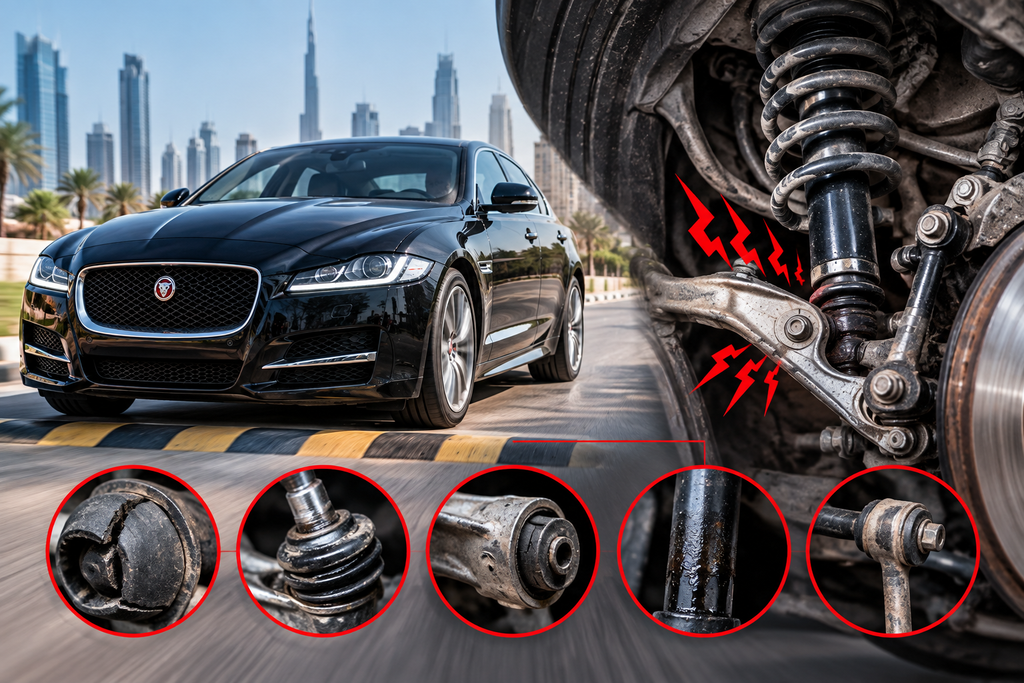
Suspension noise is any knock, clunk, rattle, creak, squeak or groan that comes from the chassis while you drive over bumps, turn the wheel or brake. It happens when a worn part moves more than it should, or when rubber that should absorb vibration has hardened and now transmits it.
The XF uses a more complex setup than most saloons:
- X250 (2008–2015): double-wishbone front suspension, a multi-link rear on a rubber-mounted subframe, and fluid-filled (hydraulic) bushes on the front lower control arms. XFR and some S models have Adaptive Dynamics electronic dampers.
- X260 (2016 onwards): an aluminium-intensive platform with double wishbones at the front and Jaguar’s Integral Link rear suspension. Many trims have Adaptive Dynamics, and the XF Sportbrake adds self-levelling rear air springs.
Knowing which generation you drive matters, because the common failure points are different.
Why Jaguar XF Suspension Noise Repair in Dubai Matters
Ignoring a suspension noise is one of the more expensive mistakes an XF owner can make. Worn parts damage the parts around them.
- A leaking lower arm bush throws the alignment out and wears the inner edge of the front tyres.
- A tired damper lets the tyre lose contact with the road, which lengthens braking distance.
- A worn ball joint can separate. At speed, that is a serious safety risk.
- A leaking rear air spring on a Sportbrake makes the compressor work non-stop until it burns out.
Worn joints, split boots and leaking dampers can also fail an RTA vehicle inspection. Dubai conditions speed all of this up:
- Heat: Summer air above 45°C and hotter road surfaces dry out rubber, so bushes crack and harden.
- Speed bumps: Communities, malls and car parks send repeated sharp loads through arms, bushes and dampers.
- Sand and dust: Fine sand gets into split boots and acts like grinding paste inside ball joints.
- Big wheels: 19- and 20-inch rims with thin sidewalls pass more impact to the suspension.
- Storage: Cars left parked through summer travel often develop dried seals and new noises once they are back in daily use.
Key Benefits of Fixing the Noise Early
- Safer driving: Stable braking and predictable steering.
- Lower total cost: A drop link or bush costs far less than a ruined tyre set, a damaged arm or a burnt compressor.
- A quieter, more comfortable cabin: The XF is meant to ride smoothly. New bushes and dampers restore that.
- Protected resale value: Service history with proper suspension work reassures buyers.
- No surprises at inspection: The car passes checks without last-minute repairs.
Common Jaguar XF Suspension Noises and What Causes Them
This table is the quickest way to match what you hear with the likely cause. It is a guide, not a diagnosis, because several faults sound alike.
| What you hear | When it happens | Most likely cause |
|---|---|---|
| Clunk or knock | Over speed bumps and potholes | Front lower control arm bush (often the hydraulic bush on the X250) |
| Light metallic rattle | Rough tarmac, paving, low speed | Worn anti-roll bar drop links |
| Creak or groan | Turning in a car park, rocking over a driveway | Upper ball joint, dried bushes, damper top mount |
| Dull clonk from the rear | Pulling away, reversing to drive, braking | Rear subframe mounts or rear link bushes |
| Bang, then bouncing | After potholes | Worn dampers, or an Adaptive Dynamics fault |
| Knocking with a sagging rear | Sportbrake after parking overnight | Leaking rear air spring |
| Hum that rises with speed | Constant, changes when weaving gently | Wheel bearing, not suspension |
The Front Lower Control Arm Bush
This is the classic XF fault, especially on the X250. The bush is filled with fluid. When the rubber splits, the fluid leaks and the arm moves freely. Owners notice a knock over bumps, a shimmy through the steering wheel at highway speed and a vague feel under braking.
Because the symptoms overlap with steering and brake faults, it is often misdiagnosed. A bush can look fine from a distance and still be empty, so it must be checked with a pry bar on a lift.
Drop Links, Ball Joints and Top Mounts
Drop links are cheap, wear quickly and cause many rattles, so they are always checked first. Creaks on turning usually point to ball joints or damper top mounts. A split ball joint boot is an early warning, because sand gets in and wear accelerates.
Rear Clonks
Rear clonks are often blamed on suspension when the real cause is a gearbox mount, propshaft coupling or engine mount. A good technician checks all of these before replacing anything.
Important Factors to Consider Before Repair
Your model and specification. An X250 hydraulic bush problem differs from an X260 Integral Link bush issue. A Sportbrake with air springs needs different checks from a coil-sprung saloon.
Electronic systems. On Adaptive Dynamics cars, a suspension warning on the dash may come from a damper, a sensor, wiring or even a weak battery. Reading these faults needs JLR-level diagnostic software such as Pathfinder or SDD. A basic OBD reader cannot see chassis modules.
Part quality. Bushes made from cheap rubber often fail within months in Dubai heat. Genuine or OE-quality parts hold their stiffness and last much longer.
Modifications. Lowering springs, larger rims and wide tyres all increase wear on bushes and joints.
Accident history. A previous kerb or pothole strike can leave a bent arm or shifted subframe. If the noise started after an impact, alignment and geometry need checking too.
Best Practices and Expert Recommendations
- Do not guess. Replacing parts one by one costs more than a proper diagnosis.
- Replace in axle pairs. Dampers, springs and arm bushes should be changed on both sides so the car stays balanced.
- Tighten bushes at ride height. Bolts torqued while the suspension hangs pre-twist the rubber and cause early failure and new noises.
- Always align afterwards. Any arm, bush or tie rod work needs a four-wheel alignment.
- Calibrate where needed. Newer XFs may need ride height sensors or driver-assistance systems reset after suspension work.
- Slow down for speed bumps and take them straight on.
- Check tyre pressures often in summer.
- Inspect the suspension at every service, not only when a noise appears.
When to Stop Driving and Call a Workshop
Some noises should not wait. Avoid driving the car and arrange recovery if you notice:
- a sudden loud bang followed by pulling to one side
- a wheel that seems to lean or wobble
- a suspension warning with a visibly lowered corner
- a metallic grinding that changes with steering input
How Professional Services Help
Suspension noise is a symptom, and the same sound can come from three or four different parts. A professional workshop turns guesswork into a clear answer.
A proper inspection combines a road test to reproduce the noise, a lift check with the suspension both hanging and loaded, and a scan of the chassis modules on cars with Adaptive Dynamics or air springs. It also looks at tyre wear patterns and alignment readings, because they reveal how long a fault has been developing.
Professionals also have the equipment that home or roadside fixes lack: a lift, press tools for bushes, correct torque procedures and an alignment rack. The result is a repair that fixes the real cause, not one that moves the noise somewhere else.
Why Choose Auto Doctor
We treat the Jaguar XF as a specialist car, not a general-service job.
- Diagnosis before parts: We find the cause first, so you only pay for what the car needs.
- Clear explanations: We show you the worn part and explain why it failed, in plain language.
- Dubai-aware repairs: We recommend parts and repair methods that handle heat, sand and speed bumps.
- Complete care under one roof: Suspension, steering, brakes and alignment are checked together, since they affect each other.
- Honest advice: If a noise comes from a mount or a bearing instead of the suspension, we tell you.
Our Suspension Repair Process
- Listen to you. We ask when the noise happens, at what speed and on which surface.
- Road test. A technician reproduces the noise.
- Lift inspection. Each bush, joint, link, mount and damper is checked by hand and with a pry bar.
- Electronic scan. On Adaptive Dynamics and air suspension cars, we read fault codes from the chassis modules.
- Written findings and quote. You see what is worn, what is urgent and what can wait, before any work starts.
- Repair. Parts are replaced with correct quality components, in pairs where needed, and torqued at ride height.
- Alignment and calibration. A four-wheel alignment is done, with sensor calibration if the car needs it.
- Final road test. We confirm the noise has gone before handing the car back.
Frequently Asked Questions
Why is my Jaguar XF making a clunking noise over speed bumps?
The most common cause is a worn front lower control arm bush, especially on the X250. Worn drop links, ball joints and dampers can also clunk. A lift inspection identifies which one it is.
Is it safe to drive a Jaguar XF with suspension noise?
Light rattles are often not urgent, but you cannot know the cause without checking. Knocks, clunks and creaks on turning can mean a worn ball joint, which is a safety issue. Get it inspected promptly.
How much does Jaguar XF suspension repair cost in Dubai?
It depends on the cause. A drop link is a small job, while control arms, adaptive dampers or an air spring cost more. Parts quality, model year and whether alignment is needed also affect the price. A diagnosis gives you an accurate quote.
Can heat in Dubai damage suspension bushes?
Yes. Prolonged high temperatures and UV dry out rubber, so bushes and ball joint boots harden and crack. This is one reason XF suspensions wear faster here than in cooler countries.
Why does my XF show a suspension warning on the dash?
On cars with Adaptive Dynamics, the cause can be a damper, a sensor, a wiring fault or low battery voltage. A scan with JLR-level software shows which one it is.
Should I replace suspension parts in pairs?
For dampers, springs and control arm bushes, yes. Replacing one side leaves the car unbalanced and the new part wearing against an old one.
Do I need a wheel alignment after suspension repair?
Yes. Any work on arms, bushes or steering parts changes the geometry, so a four-wheel alignment protects your tyres and handling.
Conclusion
A Jaguar XF suspension noise is an early warning. Dubai’s heat, speed bumps and sand make worn bushes, links and joints more likely, and a small fault left alone tends to damage tyres, alignment and eventually safety.
The right approach is simple: identify the exact cause, use good quality parts, replace in pairs where needed, torque correctly and align afterwards. That is how a Jaguar XF gets its quiet, composed ride back.
Fix Your Jaguar XF Suspension Noise Today
Do not wait for a small rattle to turn into a costly repair. Book a suspension inspection for your Jaguar XF at Auto Doctor.
- WhatsApp us a short voice note or video of the noise: [WhatsApp Number]
- Call us to speak to a technician: [Phone Number]
- Request a quote through autodoctor.ae
Tell us your XF model year and when the noise happens, and we will tell you what to expect before you bring the car in.