
The Maserati Levante brought genuine Italian sports-car character to the SUV segment, built on a platform closely related to the Ghibli and Quattroporte, and equipped with an adaptive air suspension system standard across most trims. It’s a distinctive, desirable vehicle in Dubai — but between its air suspension complexity and its dense electronics, it also has a well-known pattern of recurring issues that owners should understand.
Air Suspension Symptoms
- Sagging ride height, particularly on one side or corner, most noticeable after the car has sat parked for a while
- Suspension warning message on the dashboard, sometimes accompanied by the system locking into a fixed height
- Compressor running longer than normal or making an audible straining sound
- Uneven ride height side-to-side visible on level ground
- Harsh, jarring ride where the suspension previously felt smooth and adaptive
- Failure to switch properly between comfort, normal, and sport suspension settings
As with other adaptive air suspension platforms, the underlying causes are typically an aging air strut losing its seal, a weakening compressor, or a faulty ride-height sensor — all of which are accelerated by sustained heat exposure.
Electrical and Electronic Gremlins
The Levante has a reputation, shared with several Maserati and Fiat-Chrysler-platform-era vehicles, for occasional electrical quirks that can be more varied and harder to pin down than a single, well-defined fault:
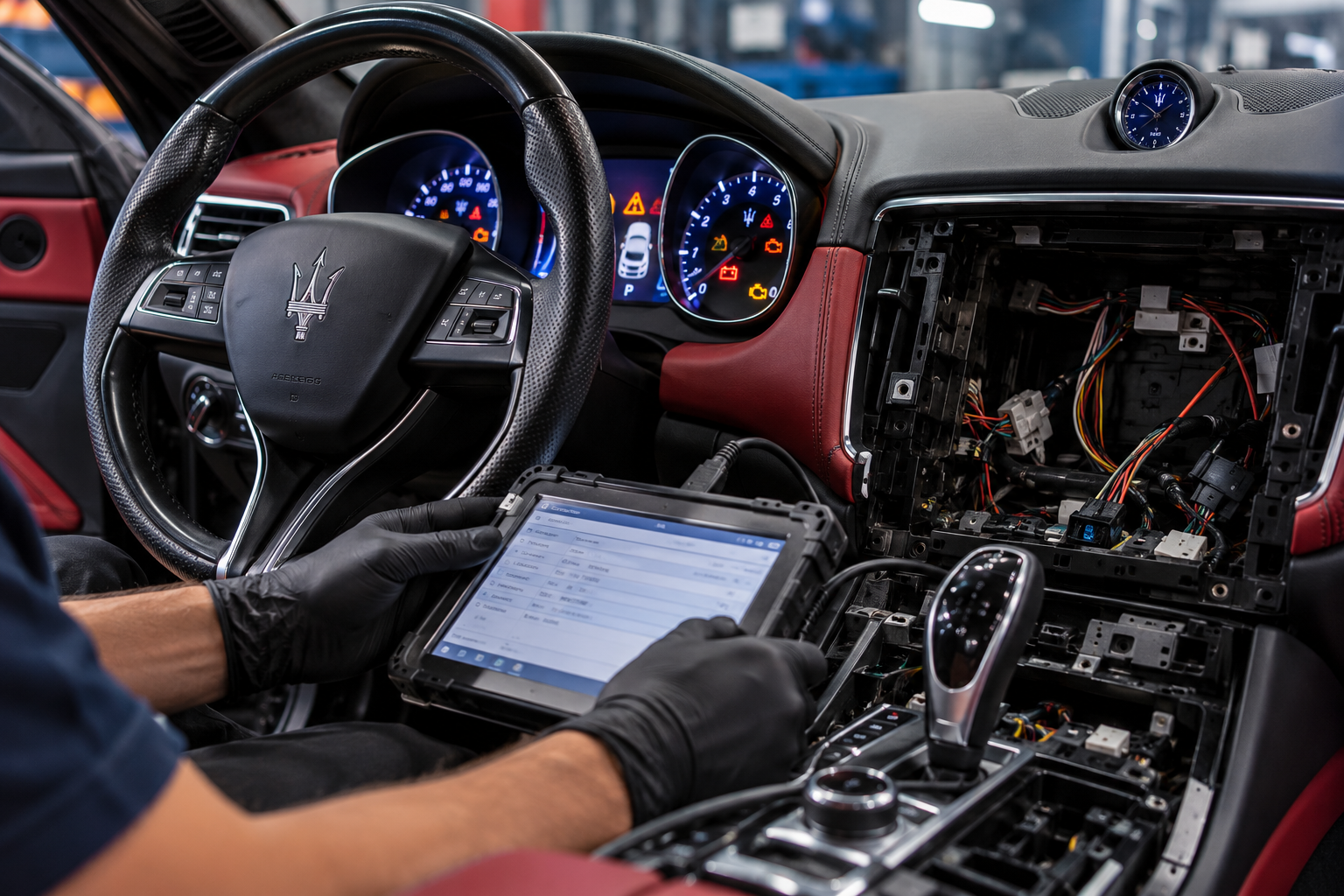
- Dashboard warning lights appearing intermittently without an obvious triggering cause
- Infotainment system freezing or restarting unexpectedly
- Window and mirror control glitches, including delayed or unresponsive operation
- Battery drain issues when the car sits unused for extended periods, sometimes traced to a module failing to enter proper sleep mode
- Sensor-related warning lights (parking sensors, tire pressure monitoring) that clear and reappear without a persistent underlying fault being obvious
Why Diagnosis Matters More on the Levante Than Most Brands
Because Levante electrical issues can stem from a wide range of causes — module software glitches, wiring connector corrosion, a weakening battery masquerading as multiple unrelated faults, or genuine component failure — a full, systematic diagnostic scan across all vehicle modules (not just the one displaying a warning) is significantly more valuable on this platform than a symptom-by-symptom guessing approach. A weak or aging battery in particular can produce a cascade of seemingly unrelated warning lights that all resolve once the actual root cause (the battery) is addressed.
Why Dubai’s Climate Compounds Both Issues
- Air suspension: sustained extreme heat accelerates degradation of the rubber air strut seals and puts the compressor under greater thermal and mechanical stress, exactly mirroring the pattern seen across other air-suspension luxury SUVs in this climate.
- Electronics and battery: heat is one of the most significant accelerants of battery chemical breakdown, and a weakening battery in a Levante’s already electronics-dense architecture can trigger a wider range of secondary symptoms than in a simpler vehicle.
- Extended parking in direct sun: raises interior and under-hood temperatures well beyond the conditions many of these systems were validated against, contributing to both suspension seal wear and electronic connector degradation over time.
Diagnostic and Repair Approach
- Battery load test first — given how often battery weakness masquerades as unrelated electrical faults, this should be ruled out before chasing individual warning lights
- Full module-wide fault code scan, not just the module currently displaying a warning
- Air strut and compressor inspection if any suspension symptom is present, to isolate the specific failed component
- Software version check on infotainment and relevant control modules against the latest available update
Preventive Tips for Levante Owners
- Don’t let the vehicle sit unused for extended periods without starting it — this stresses both the battery and the air suspension system, which slowly loses air pressure over time when parked
- Address a hissing sound or visible sag immediately rather than waiting for a full suspension warning
- Have the battery load-tested annually once past 18 months old, given how it can trigger unrelated-looking electrical symptoms
- Keep infotainment and module software updated to reduce the frequency of software-related glitches
FAQ
Are Maserati Levante electrical issues a sign of a fundamentally unreliable car?
They’re a known characteristic of this platform’s electronics-dense design, and many reported issues trace back to a small number of root causes (battery health, software versions) rather than indicating widespread component failure across the vehicle.
Should I always suspect the battery first on a Levante with dashboard warnings?
It’s a sensible first check given how often battery weakness in this platform produces a cascade of seemingly unrelated warning lights, though a full diagnostic scan is still needed to confirm.
Is Levante air suspension repair similar to other Maserati or Fiat-Chrysler-platform vehicles?
There’s meaningful platform overlap with the Ghibli and Quattroporte, which can help an experienced specialist diagnose faster, though exact parts and calibration should always be confirmed against the specific vehicle.
How often should a Levante’s air suspension be inspected?
At every major service at minimum, with prompt attention to any hissing sound or visible sag rather than waiting for a full warning light.
Dealing with a sagging ride or unexplained warning lights on your Levante? Call Auto Doctor or WhatsApp us for a full diagnostic.